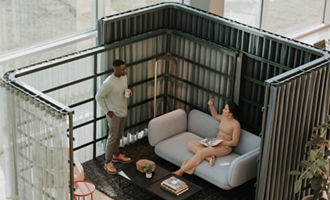
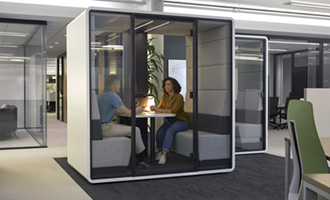
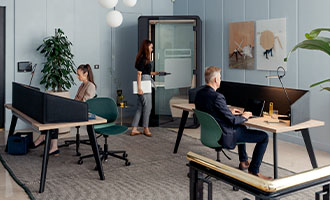
We believe that noise dissatisfaction can be solved by creating acoustic ecosystems. When workspaces offer a wide range of acoustic environments, people can choose the best setting for each activity. Each setting in an acoustic ecosystem has a distinct profile – thanks to a unique combination of acoustic solutions that absorb, block, contain, or displace sound – which helps people focus or collaborate without distracting nearby colleagues.
14/09/2026 • 5 min read
Acoustic ecosystems: how the best workplaces design sound
The most effective offices aren’t simply the quietest
For most people, the office is simply too noisy. Workplace noise has been a consistent problem for years. Acoustic dissatisfaction is common across geographies and work cultures, and it affects organisations of all sizes.
Noise is complicated. The most distracting noise comes from colleagues – so the very people we collaborate with in the morning are the source of our distractions in the afternoon. Workplace noise can’t be solved with a new product or a single behavioural change. Even moving around the office won’t help if there are distractions near every setting. And because individuals and teams alike have unique acoustic preferences, there truly is no one-size-fits-all solution.
But what if workplaces offer a wide range of settings that are acoustically suited to different activities – and people have the freedom to choose what works best for them?
In this article, we’ll delve into the most distracting part of noise: speech intelligibility. Then we’ll look at examples of acoustic settings that help people do their best, undistracted work. These settings feature a strategic mix of acoustic elements that absorb, block, contain, or displace sound – and when many of these settings combine, they form an acoustic ecosystem.

Dissatisfaction with office noise levels is a global problem
Leesman studies have found that only 35% of people are satisfied with noise levels in their offices. That’s a significant issue, especially when 89% of those same respondents consider individual focus work an important workplace activity.
Leesman has found that overall satisfaction is flat, hovering in the mid-30s in recent years. But there are promising signs: among top-tier Leesman+ spaces, satisfaction with noise levels sits at 45% – 10 percentage points higher than the average office. While still not ideal, that gap indicates that high-performing workspaces can increase acoustic satisfaction.
Those clear, big-picture stats show us that noise is a problem – and that it can be addressed. But why are people dissatisfied? And what are some workplaces doing correctly when acoustic satisfaction increases?
What is speech intelligibility – and why is it so important in offices?
Speech intelligibility is how clearly you can understand what someone is saying – and it has a proven impact on performance.
Speech is one of the most common workplace distractions. Gensler research found that only 11% of people are not typically distracted at their desks – meaning the vast majority find it difficult to focus (link to study – download required). The two highest-ranking distractions involved overhearing colleagues, either on phone calls or talking with their teams.
Overhearing intelligible speech from colleagues has a negative impact. Decades-long research in Finland has concluded that work performance generally decreases as speech intelligibility increases.
Speech, it seems, is uniquely distracting. And tasks that are more cognitively demanding appear to be impacted more by speech distractions than routine tasks – so overhearing colleagues chatting will disrupt you precisely when you need to focus most.
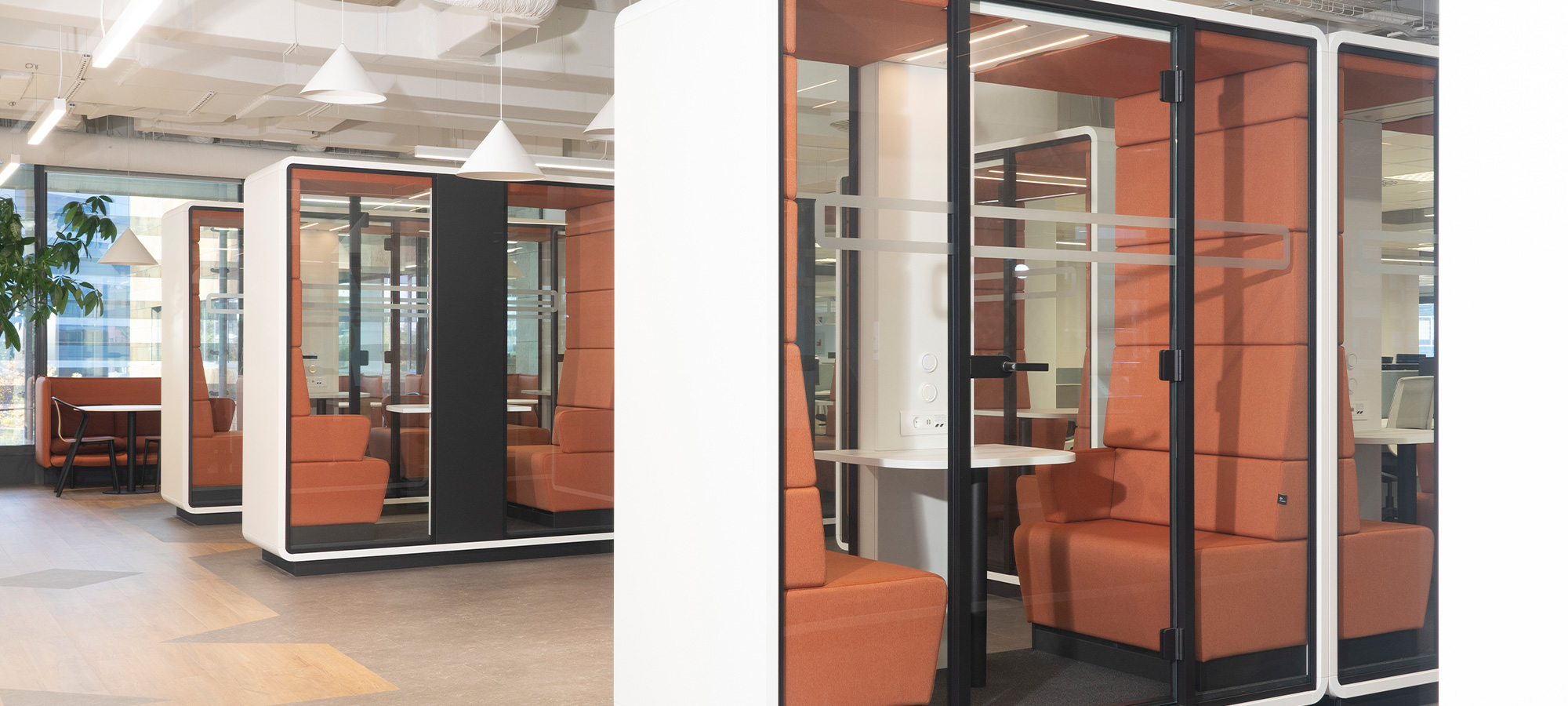
Speech intelligibility is a strategic tool, not a problem to be eradicated
Even though speech intelligibility is a proven source of distraction, the solution is not to simply make all speech unintelligible. A recent study by Kang et al found that speech intelligibility is a two-sided goal: it seems ideal to have high speech intelligibility within a team and low speech intelligibility between teams.
This makes sense when we think about speech intelligibility as communication, clearly understood. Sometimes, you want to understand communication clearly. When your colleague is updating you on a task you’re both working on, you don’t want to struggle to understand her. At the same time, if you can understand every word as another team talks about a project that has nothing to do with you, it’s going to be very difficult to maintain focus on your work.
So speech intelligibility is less a problem to be eradicated and more a strategic decision for each setting. You want high speech intelligibility within a large meeting room or one team’s project area, so that everyone can be understood without having to repeat themselves or strain their voices. And you want speech intelligibility to be low between a collaborative setting where colleagues are chatting and a focus area where people need to concentrate.
As offices become social hubs for collaboration, who can be understood – and where – will only become more important for acoustic strategy.
Acoustic ecosystems let you choose the best setting for each task
Acoustic agency – the power to choose your acoustic environment – may be key to workplace satisfaction. By creating a range of acoustic settings within one workplace, acoustic ecosystems let individuals and teams select the best setting for the task at hand.
Settings gain unique acoustic profiles by strategically mixing solutions that absorb, block, contain, and displace sound – the ABCDs of acoustic strategy.
- Products that absorb sound reduce reverberation time, or how long sound lingers in a space. Shorter reverberation time can make a setting feel calmer and less distracting.
- Some solutions block noise from crossing between settings, interrupting the path between collaborative area and focus zone, for example.
- Enclosed settings such as phone booths contain noise at its source. This gives people high speech privacy while preventing nearby colleagues from being distracted by intelligible speech.
- Acoustic elements can displace noise by relocating some louder, distracting activities to more suitable locations. Phone booths serve this purpose. Even a low table in a lounge area serves to invite people to sit down with a coffee and have a quick catch-up.
Here are three space types that use different mixes of the ABCDs to suit various activities.
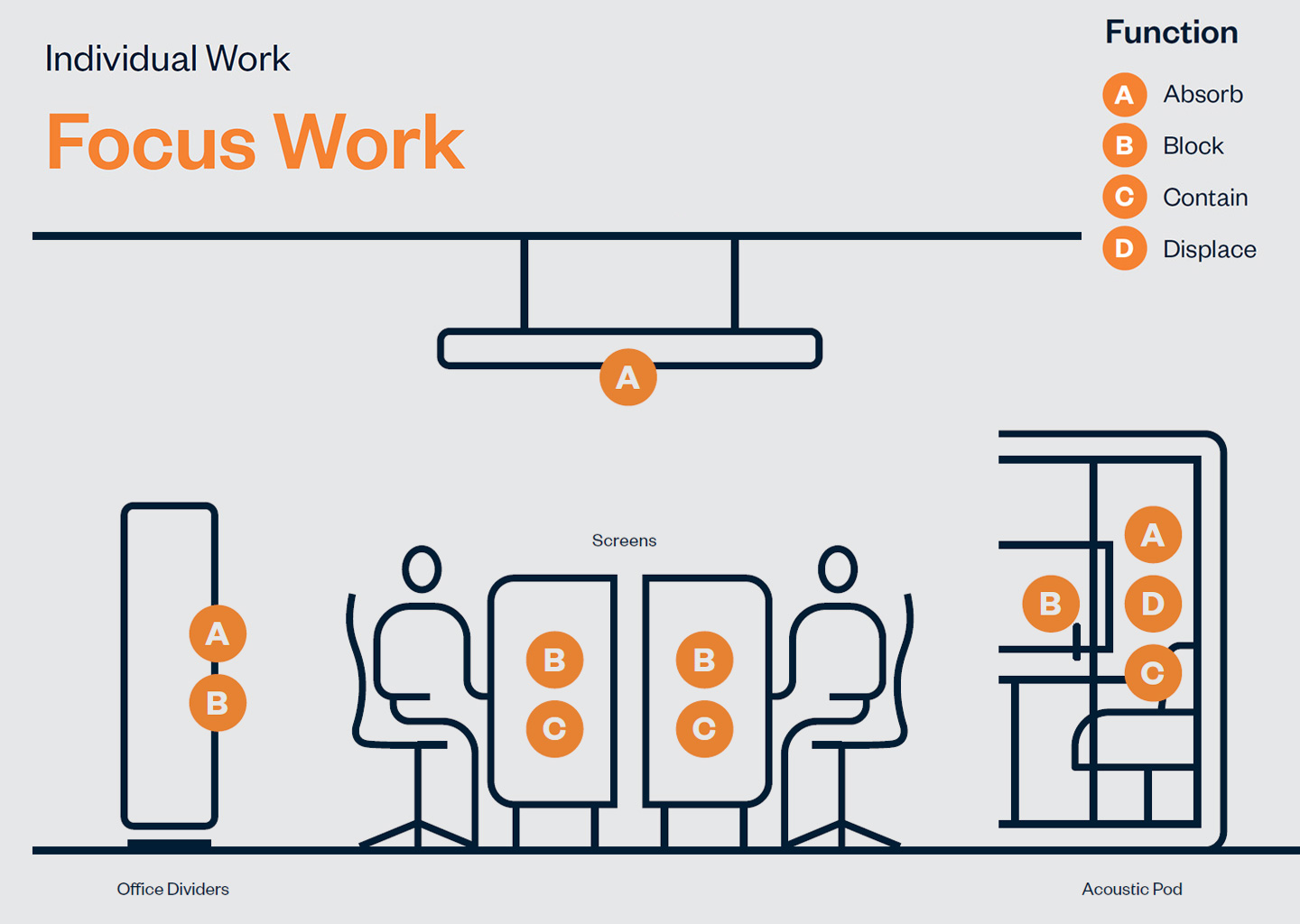
Focus work setting: reduce intelligible speech near concentration areas
A focus work setting supports concentration by reducing intelligible speech from nearby areas. In this example, all four acoustic components combine to reduce speech intelligibility. Acoustic lighting and dividers absorb sound, screens and dividers interrupt direct sound paths, and a nearby phone booth displaces calls to a setting where conversations can be contained. The result is a setting where people can stay connected without having to process every nearby conversation.
Acoustic Elements
- Booths & Acoustic Pods
- Office Dividers
- Screens/Desk Partitions
- Wall Coverings
- Acoustic Lighting
- Acoustic Ceiling
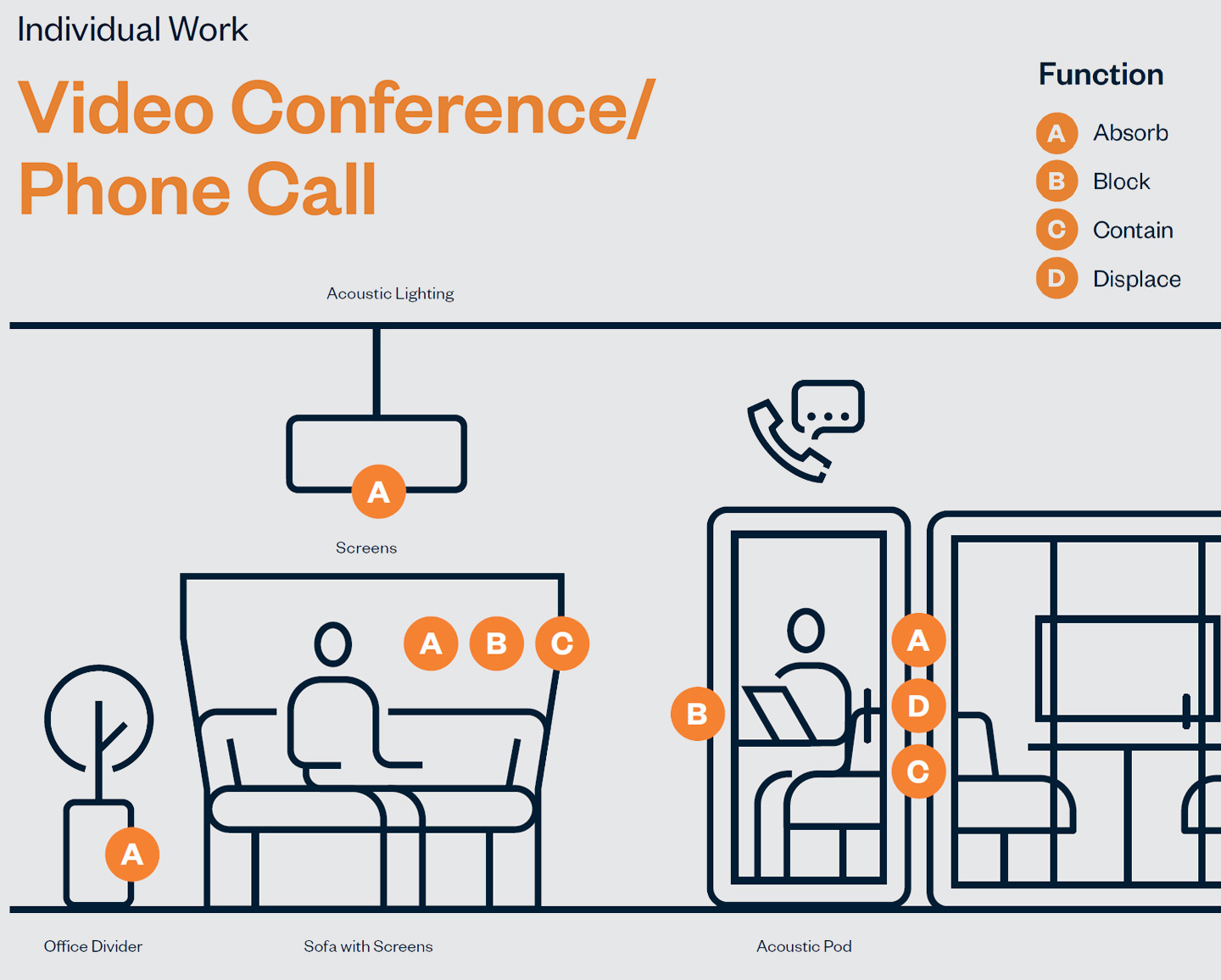
Phone booth for video calls: contain private speech at the source
Many people seem to be on calls all day – and while these conversations are important for the people talking, they can be immensely distracting to people working nearby. A phone booth supports calls by keeping speech clear inside the booth and less intelligible outside it. Phone booths located near individual work areas displace these potentially distracting conversations, keeping the space calmer for everyone nearby.
Acoustic Elements
- Booths & Acoustic Pods
- Office Dividers
- Screens/Desk Partitions
- Wall Coverings
- Acoustic Lighting
- Acoustic Ceiling
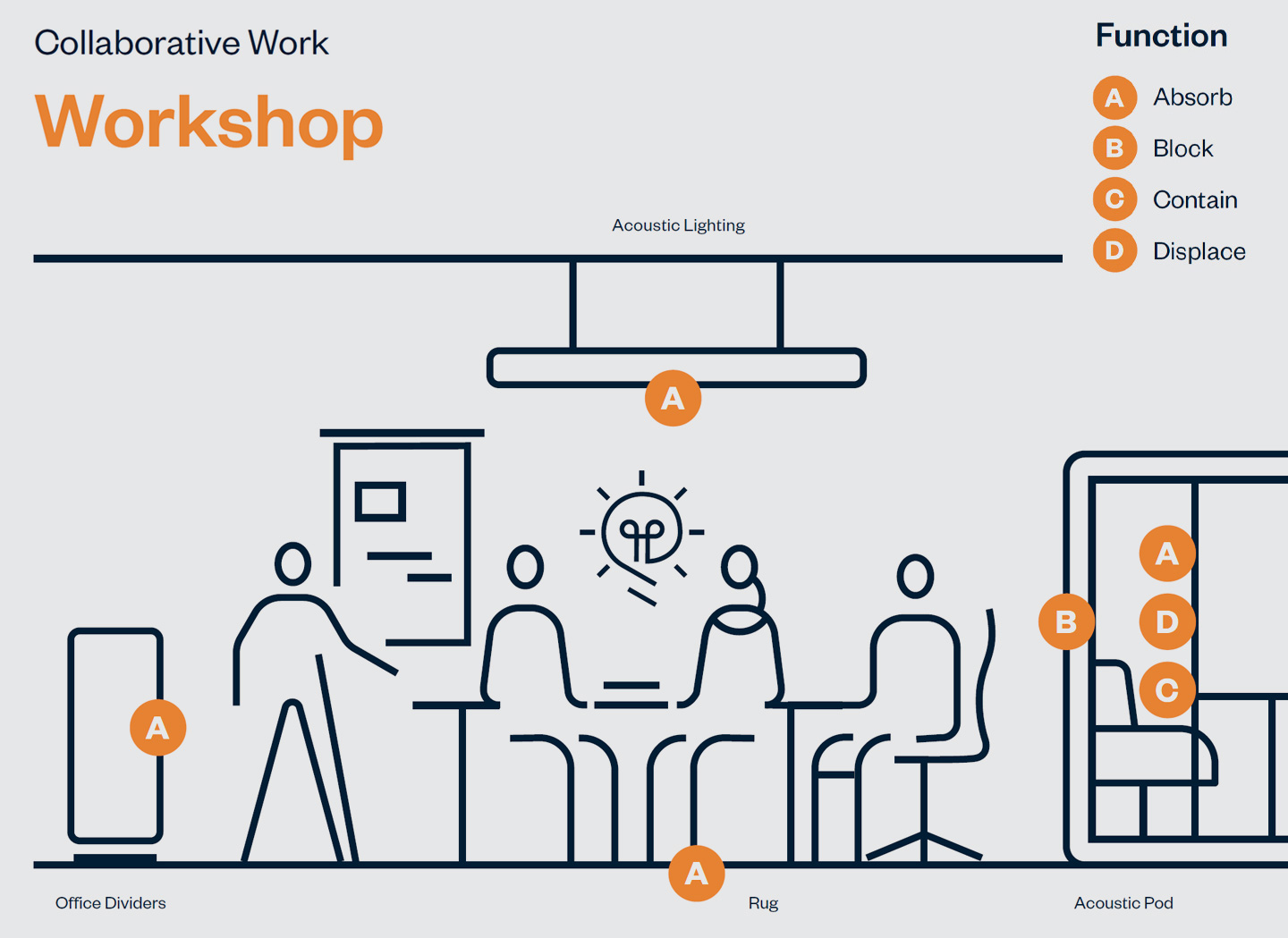
Workshop: support active collaboration without disrupting focus work
A workshop setting supports active collaboration by giving louder group work a suitable place to happen. These spaces need to bring out everyone’s best ideas – and high speech intelligibility helps. If these sessions are too quiet, it can be intimidating to share an unexpected or improbable idea – so these settings are tuned to allow an energetic background buzz that encourages creativity. Absorptive elements keep reverberation levels reasonable, while screens, dividers, or nearby enclosed settings reduce how much sound reaches neighbouring areas. An optional phone booth or meeting pod gives people a place to take quick calls before rejoining the team.
Acoustic Elements
- Booths & Acoustic Pods
- Office Dividers
- Screens/Desk Partitions
- Wall Coverings
- Acoustic Lighting
- Acoustic Ceiling
Explore the Acoustic Design Guide to see how these principles come to life across workplace settings, solutions, and real project examples.
Acoustic terms to know
- Acoustic ecosystem: a workplace with a range of distinct acoustic settings made up of varying elements that absorb, block, contain, or displace sound – such as phone booths, ceiling and wall treatments, soft seating, and rugs.
- ABCD: Haworth’s four-part strategy for acting on sound:
- Absorb: reduce echo and reverberation within a space
- Block: stop sound from crossing between spaces
- Contain: keep sound at its source
- Displace: move noisy activity to a more suitable place
- Speech intelligibility: how clearly speech can be understood. Audible speech is not necessarily distracting; it’s when speech is intelligible that distractions rise. The intended audience should hear speech clearly, but nearby colleagues should not be distracted. Ideal speech intelligibility depends on each setting: it should be high in a meeting room and low in a focus area, for example.
- Speech privacy: keeping private conversations private. While similar to speech intelligibility, speech privacy focuses on maintaining confidentiality for the people speaking rather than reducing distractions for colleagues nearby.